
Keeping a Maintenance Log: The Habit That Protects Your Car's Value
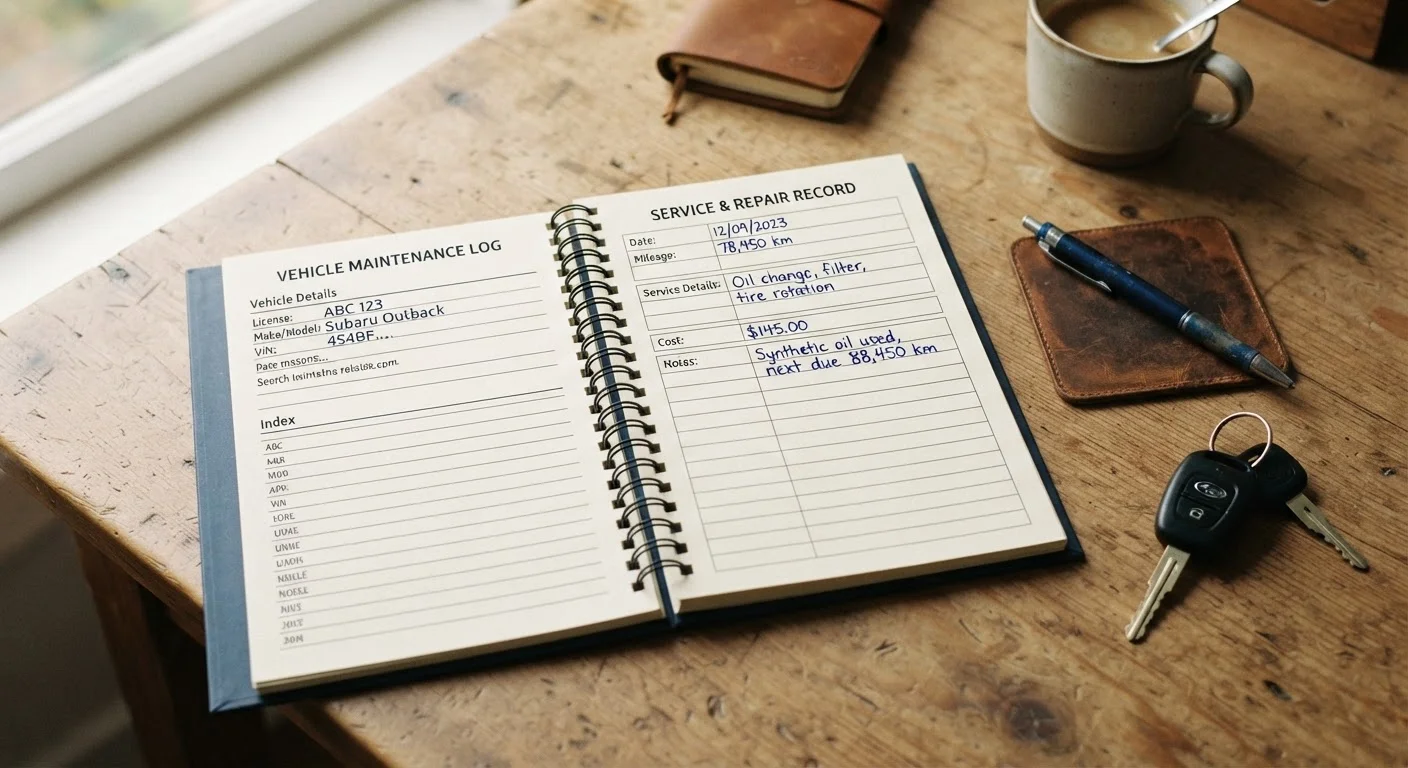
Photo credit: healthmatters.site
In this article
A well-kept vehicle maintenance record can lower repair costs, support warranty claims, and preserve resale value. Here is how to build one.
Key Takeaways
- A maintenance log documents every service event, creating a verifiable history that supports resale value.
- Buyers and dealers often pay more for vehicles with complete, legible service records.
- Logs help catch skipped intervals before they become costly mechanical failures.
- Both paper notebooks and digital apps work; consistency matters more than the format.
- A log can support warranty claims and dispute repair charges when something goes wrong.
Why a maintenance log matters more than most owners realize
Most families track their car spending through memory and a loose pile of receipts. That approach fails at the worst moments: when a buyer asks for service history, when a dealer questions a warranty claim, or when a mechanic says the transmission fluid has never been changed. A maintenance log converts scattered receipts into a coherent record you can actually use.
Depreciation strips most vehicles of a large share of their value in the first few years, but condition and documented history influence how fast that decline happens. A car with a clean, complete log tends to command a stronger private-sale price than an identical vehicle without one, because buyers can verify the claims a seller makes. That difference can be meaningful on a $15,000 to $25,000 used vehicle.
Logs also function as an early-warning system. When every oil change, tire rotation, and fluid top-up is written down, it becomes easy to see what is overdue at a glance rather than guessing from the last sticker on the windshield.
Start today, even mid-ownership
You do not need to own the car from new for a log to be useful. Starting a log at 60,000 miles still gives the next buyer, your mechanic, and your insurer a documented record of what has happened since you took over. A partial history is more useful than none.
What to record in each log entry
Every entry should answer four questions: what was done, when, at what mileage, and who did it. Beyond that core, recording the cost gives you a running total of annual maintenance spending, which feeds directly into the annual vehicle cost review many families skip.
- Date of service
- Odometer reading Service performed (oil change, brake pad replacement, tire rotation, etc.)
- Parts used, including part numbers if available
- Labor cost and shop name, or "DIY" if you did the work yourself
- Next recommended service interval or mileage
If a shop provides a multi-point inspection sheet, staple or clip it to the corresponding page. That sheet can show a potential buyer or warranty adjuster that the vehicle was inspected professionally, not just serviced on the cheapest items.
Several ownership costs that families underestimate, such as tire replacement and brake work, are easier to anticipate when the log makes the service timeline visible.
Do not alter or backdate entries
Editing a maintenance log to hide missed service intervals or to show work that was not done is fraudulent misrepresentation when selling a vehicle. Courts have awarded damages to buyers who proved a log was falsified. Record what actually happened, including any gaps, and note estimates as estimates.
How to set up your log in six steps
What you will need
Gather your existing records
Pull together every receipt, inspection sheet, and dealer invoice you have. Check the glovebox, email inbox (search the dealer's name), and any folder where you store vehicle paperwork. These form the historical section of your log and show a buyer or adjuster that coverage predates today.
Choose your format
A simple spiral notebook works if you write legibly and keep it in the glovebox. A spreadsheet stored in cloud storage works if you prefer searching by date or mileage. Some owners use a dedicated vehicle maintenance app, which can send service reminders. Pick whatever you will actually update after every service visit.
Create an opening vehicle profile page
Before your first log entry, write down the vehicle identification number (VIN), year, make, model, trim level, engine size, and transmission type. Add the purchase date and odometer reading at purchase. This page anchors every subsequent entry and makes it easy to look up parts or recall bulletins specific to your exact configuration.
Enter your historical records in chronological order
Working from oldest to newest, log each service event you found in step 1. If a receipt is missing but you remember an approximate date and mileage, note it as an estimate and mark it clearly. Honesty about gaps protects you legally and ethically when selling.
Log every future service event within 48 hours
The log only works if it stays current. After each oil change, tire rotation, or repair, write the entry before the receipt gets lost. Set a phone reminder for the day after any scheduled service as a prompt to update the log. Note the next due interval so you can see at a glance when the car is due for attention.
Review the log at least once a year
At your annual review, check whether any factory-recommended services are overdue, add up total maintenance costs for the year, and confirm the log is legible and complete. This review fits naturally into the broader annual vehicle cost checkup that covers insurance, fuel, and financing as well.
Once the log is running, pair it with the guidance on which car care tasks to do yourself to decide which entries will carry a shop cost and which you can record as DIY work. Either way, document it.

Author
Car Ownership Savings Editorial Team
Car Ownership Savings Editorial Team is the collective byline for our editorial team and contributor network. Articles published under this byline or an editorial pen name are researched, written, and reviewed according to our editorial standards for clarity, consistency, and independence before publication.
View all articles →