
Zero-Based Budgeting vs. Envelope Budgeting: Which Fits Your Household?
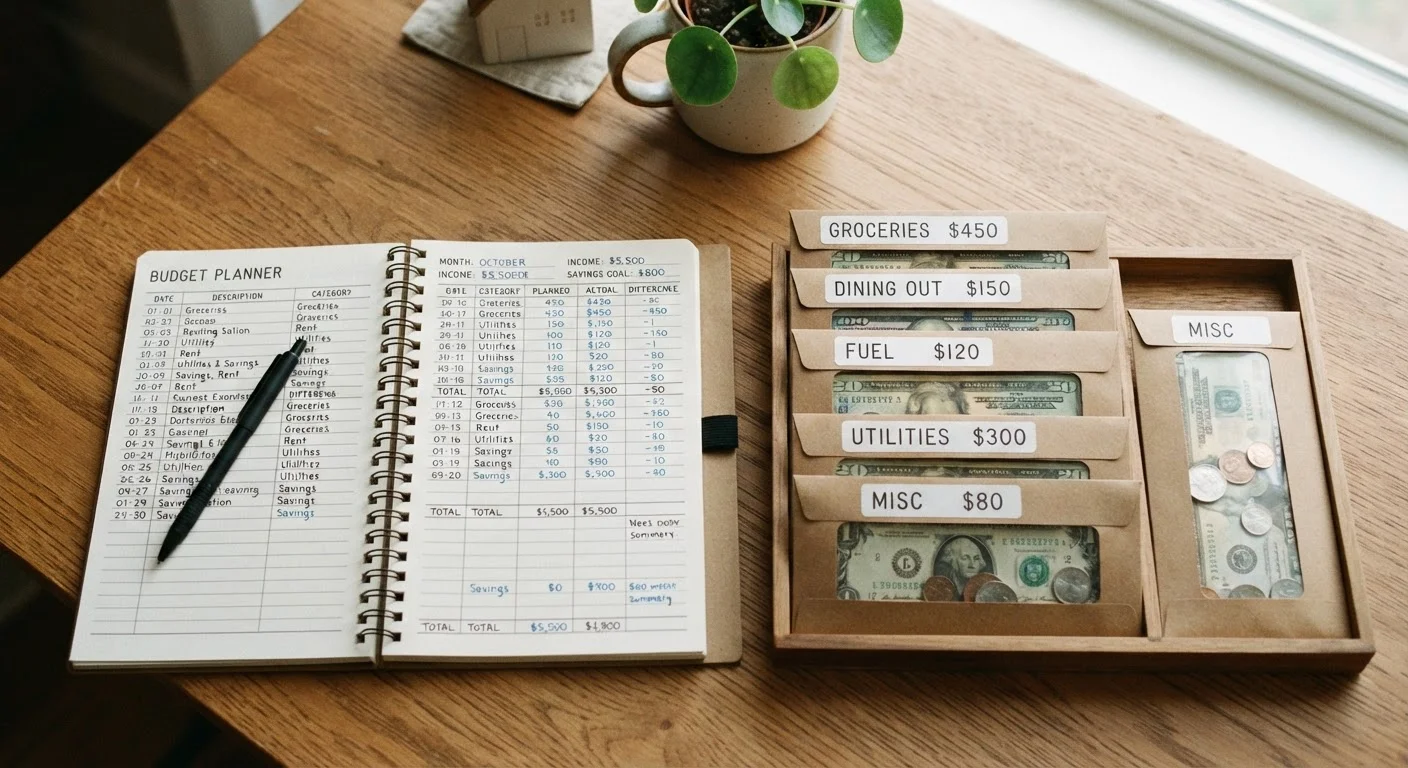
Photo credit: healthmatters.site
In this article
Compare two popular household budgeting methods side by side to understand their trapb-offs and find the approach that suits your family's habits.
Key Takeaways
- Zero-based budgeting assigns every dollar of income to a specific category until nothing is left unallocated.
- Envelope budgeting divides cash into labeled spending categories, stopping purchases when each envelope empties.
- Both methods require intentional monthly planning; neither works passively without consistent attention.
- Zero-based budgeting suits digital-first households; envelope budgeting works better for cash-reliant spenders.
- Families can combine elements of both methods to match their real spending habits.
How zero-based budgeting works
Zero-based budgeting (ZBB) starts with one rule: income minus expenses must equal zero. That does not mean spending every dollar; it means every dollar gets a job. You list your monthly take-home income, then assign amounts to categories: housing, groceries, utilities, debt payments, savings, and so on, until the balance reaches zero.
The process runs from the top down. You begin with what you actually earn that month, not an average, and you rebuild the plan each time. If a category goes over, you pull from another. Nothing is left in a vague "leftover" pool, which is where most unplanned spending hides. See why that untracked remainder causes problems for a deeper look at that pattern.
ZBB works well alongside tools like sinking funds, where you pre-save for predictable irregular costs. Sinking funds can occupy their own line in a zero-based plan, making the method more complete for families with annual expenses like car registration or school fees.
How envelope budgeting works
Envelope budgeting divides spending money into physical envelopes, each labeled for a category: groceries, gas, clothing, eating out. You load each envelope with the cash allocated to that category at the start of the month. When the envelope is empty, spending in that category stops until the next refill.
The original version uses actual cash and paper envelopes. Digital versions replicate the concept with virtual envelopes inside budgeting apps, where a transfer out of one category visually depletes its balance. Both versions enforce the same constraint: a hard limit per category that requires a conscious decision to override.
The method targets variable spending categories most directly. Fixed costs like rent or a car payment are harder to put in envelopes because they are paid by check or direct debit, not cash. Most families using this system handle fixed expenses separately and restrict the envelope method to discretionary categories. The gray-area categories between needs and wants are exactly where envelope limits tend to have the most impact.
Sipb-by-side comparison
The two methods share a common goal: intentional allocation of spending money. Their mechanics differ enough that the right choice depends on how your household actually behaves with money, not just how you plan to behave.
| Criterion | Zero-Based Budgeting | Envelope Budgeting |
|---|---|---|
| Core mechanic | Assign every dollar to a category | Load cash into labeled envelopes |
| Spending limit enforcement | Digital tracking and manual review | Physical cash runs out automatically |
| Best for | All spending categories | Variable, discretionary categories |
| Tool requirement | Spreadsheet or budgeting app | Cash, envelopes, or virtual app |
| Adapts to irregular income | Yes, rebuilt each month | Harder with fluctuating amounts |
| Learning curve | Moderate, requires full income mapping | Low, intuitive cash system |
| Works with card spending | Yes, track digitally | Not directly, cash preferred |
Households carrying consumer debt may find zero-based budgeting more precise for tracking extra debt payments month to month. Balancing debt payoff and saving is easier when each goal has its own budget line, which ZBB accommodates directly.
Choosing the right fit for your household
Neither method is superior in every situation. The question is which one matches how your family already manages day-to-day transactions.
If most of your spending is on a debit or credit card, cash envelopes create friction: you withdraw cash, use it, and then reconcile receipts. For card-heavy households, a zero-based plan tracked in a spreadsheet or app creates the same accountability without the extra steps. If your household already uses a subscription audit process, ZBB is a natural next layer because recurring charges fit cleanly into dedicated budget lines.
If your family regularly exceeds the grocery or dining budget and a digital tracker has not changed that behavior, the physical envelope may work where software has not. The act of handling cash and watching an envelope thin out creates a concrete feedback loop that a screen notification often cannot replicate.
Some households combine the two: they build a zero-based monthly plan for the full income, then pull cash envelopes only for the two or three categories where overspending is a consistent problem. That hybrid keeps the structure of ZBB while using the physical constraint of envelopes where it is most needed. You can also apply either method to larger goals, like setting aside money for a trip. See how families manage vacation spending for practical ideas on that front.
This article is for general informational purposes only and does not constitute personalized financial advice. Consult a qualified financial professional for guidance specific to your circumstances.

Author
Smart Money Habits Editorial Team
Smart Money Habits Editorial Team is the collective byline for our editorial team and contributor network. Articles published under this byline or an editorial pen name are researched, written, and reviewed according to our editorial standards for clarity, consistency, and independence before publication.
View all articles →