
Wired vs. Wireless Headphones for Everyday Family Use
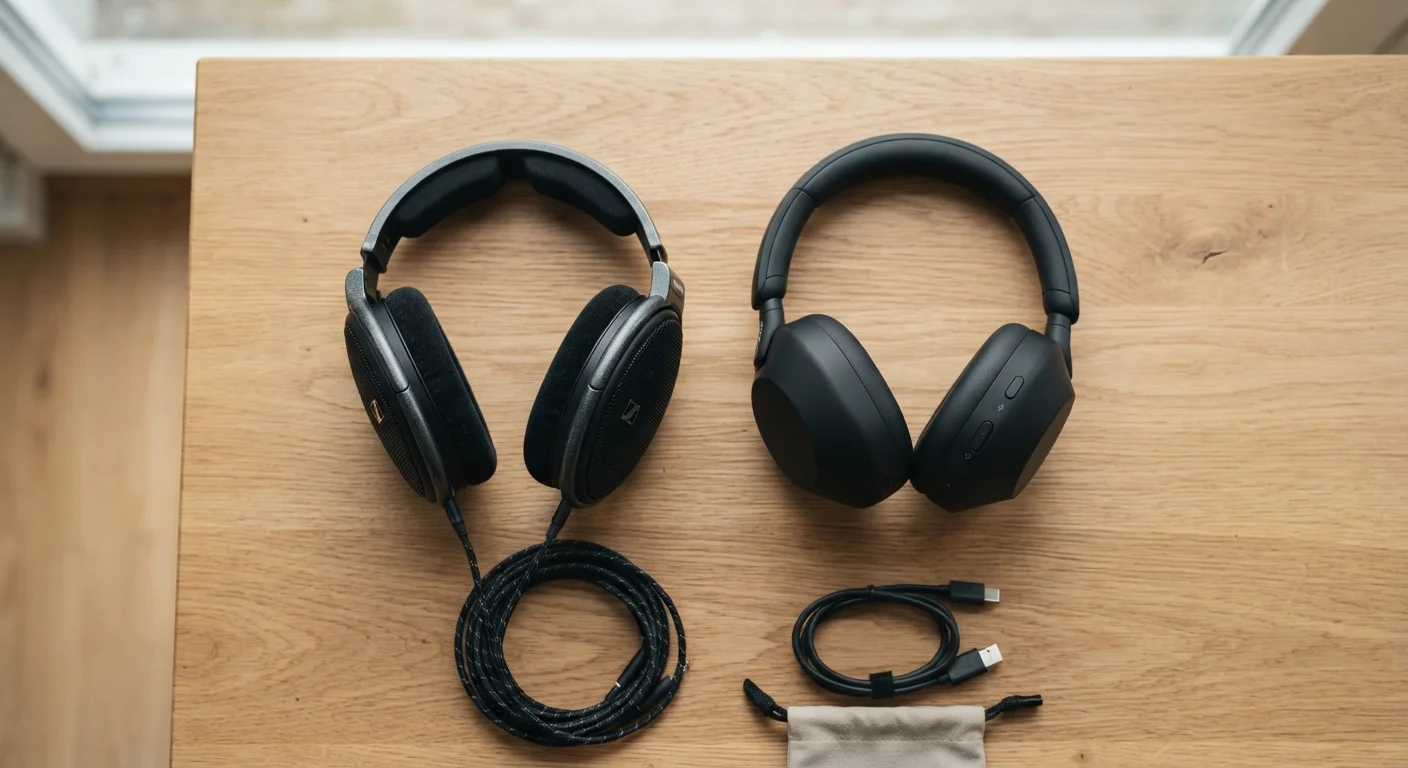
Photo credit: healthmatters.site
In this article
Sound quality, battery life, durability, and cost: a sipb-by-side look at wired and wireless headphones for busy households.
Key Takeaways
- Wired headphones cost less upfront and never need charging, making them dependable for daily school use.
- Wireless models add convenience but introduce battery management and a higher price floor.
- Sound quality at comparable price points is roughly equal; the gap narrows significantly above $50.
- Durability favors wired headphones at budget tiers; cables can fray but are sometimes replaceable.
- Wireless headphones carry hidden costs: replacement ear cushions, charging cables, and eventual battery degradation.
- Most families benefit from having one of each type rather than treating this as an either-or decision.
What you actually give up with each type
Wired headphones are simple: plug in, audio plays. There is no Bluetooth pairing, no battery percentage to monitor, and no firmware to update. That simplicity is a real advantage in households where multiple people share devices or where kids are responsible for their own gear. The tradeoff is the cable itself. Cables tangle, catch on chair arms, and eventually fray at the connector end, particularly with children who are hard on equipment. Some wired models allow the cable to be detached and replaced; many at the budget tier do not.
Wireless headphones remove the cable constraint entirely, which matters more in some situations than others. For a child sitting at a desk, the cable is rarely a problem. For a teenager doing homework while wandering the kitchen, or an adult on a treadmill, the absence of a cord is a genuine usability improvement. The cost of that freedom is a battery that needs daily or near-daily charging at moderate use levels, and the knowledge that after several hundred charge cycles the battery will hold less capacity than it once did.
| Criterion | Wired headphones | Wireless headphones |
|---|---|---|
| Typical entry price | $10 to $30 | $25 to $60 |
| Battery required | No | Yes (4 to 40 hrs per charge) |
| Audio quality at budget tier | Generally stronger | Compressed by codec |
| Main failure point | Cable fraying | Battery degradation |
| Device compatibility | 3.5mm jack or adapter | Bluetooth (universal) |
| Freedom of movement | Limited by cable | Full range |
| Shared household use | Easy plug-and-play | Requires pairing per user |
| Long-term repairability | Cable replaceable on some models | Battery rarely user-replaceable |
Sound quality and the price point reality
At price points below $50, wired headphones generally produce cleaner audio than wireless competitors at the same cost. The reason is straightforward: wireless models must allocate part of their bill of materials to Bluetooth chips and batteries, which compresses what is left for drivers and housing quality. Above $75 to $100, that gap narrows considerably, and above $150 it is largely irrelevant for everyday listening purposes.
Bluetooth audio compression is a factor worth understanding. Most wireless headphones use a codec (a format for compressing audio over Bluetooth) such as SBC, AAC, or aptX. SBC, the baseline codec, introduces some quality loss that trained ears can detect in quiet environments. For casual music listening, video calls, and kids' content, the difference is rarely noticeable. Families using headphones primarily for video streaming or online classes will not hear a meaningful quality deficit from a mid-range wireless model.
$50
Price where wireless audio quality gap closes
Consumer audio reviewers consistently note that the wired-vs-wireless fidelity difference becomes marginal for most listeners above this price threshold.
500+
Typical Bluetooth battery charge cycles before capacity drops
Lithium-ion batteries in consumer electronics commonly show noticeable capacity reduction after 300 to 500 full charge cycles, a figure widely cited by battery researchers.
3.5mm
Standard wired connector type
The 3.5mm TRS jack remains the most widely supported headphone connector across budget laptops, tablets, and audio equipment sold in the US.
If someone in the household is a serious music listener or uses headphones for audio production work, wired models at equivalent price points still deliver more raw fidelity. For the majority of family use cases, that distinction is minor.
Durability, repairs, and total cost over time
The purchase price is only part of the cost equation. Wired headphones fail most often at the cable, which is a mechanical weak point but also a fixable one on models with detachable cables. A $15 replacement cable extends the life of a $40 pair significantly. Wireless headphones have no cable failure mode, but they introduce battery degradation as a long-term cost. A pair used daily for two years may hold only 60 to 70 percent of its original charge by year three. Replacement batteries are sometimes available but often require disassembly that voids warranties.
Ear cushion wear is common to both types. Foam and leatherette pads compress and crack over time, particularly with heavy use by children. Replacement pads are available for many popular models and cost between $8 and $20, which is worth factoring in before writing off a pair that otherwise works fine. See also how families weigh similar longevity trapb-offs with tablets in our tablet trapb-offs guide.
For households with young children, build quality at the hinge and headband matters more than audio specs. Plastic hinges are a known failure point in both wired and wireless models designed for kids. Metal-reinforced headbands cost more upfront but tend to survive the wear of a school year without cracking.
Practical compatibility across household devices
Wired headphones with a 3.5mm connector work on any device that has a headphone jack. Many newer laptops and smartphones have dropped that jack entirely, which means families may need a USB-C or Lightning adapter. Those adapters cost $5 to $15 and are easy to lose. If your household runs several older devices alongside newer ones, a wired pair with an adapter will still cover most scenarios reliably.
Wireless headphones pair over Bluetooth, which nearly every current laptop, tablet, phone, and smart TV supports. Switching between devices is the friction point: most wireless headphones maintain one active connection at a time, so moving from a tablet to a laptop requires re-pairing or at minimum a manual switch. Multipoint Bluetooth, which allows simultaneous connection to two devices, is available on some mid-range and higher-end wireless models and reduces that friction considerably.
For shared family use, wired headphones win on compatibility simplicity. For a single person who uses one primary device, wireless works cleanly. Households that own a mix of both headphone types tend to find they naturally route each type to its best-fit use case without much deliberation.

Author
Budget Tech Picks Editorial Team
Budget Tech Picks Editorial Team is the collective byline for our editorial team and contributor network. Articles published under this byline or an editorial pen name are researched, written, and reviewed according to our editorial standards for clarity, consistency, and independence before publication.
View all articles →